Open-plan kitchens: design, layout and tips for integrating them into your home
Open-plan kitchens have become one of the most common design solutions in contemporary homes. Although their origins date back to the mid-20th century, it is in recent decades that this type of layout has gained prominence, driven by new lifestyles, more dynamic households and an architectural approach that favours fluid and multifunctional spaces.
Today, the kitchen is no longer a secondary room but a central space in the home. It is no longer hidden: it is integrated. The open-plan kitchen connected to the living room reflects a more social, flexible and connected way of living, where cooking, sharing and spending time together take place in the same environment.
Advantages of open-plan kitchens in modern homes
Modern open-plan kitchens respond both to practical needs and to an evolution in the way we inhabit our spaces. Among their main advantages are:
- They encourage social interaction and family life: By removing physical barriers, the person cooking can interact with the rest of the family or guests. The kitchen becomes a natural meeting point during gatherings, celebrations and daily life.
- They bring more light and a greater sense of space: Visual continuity between rooms allows natural light to flow more easily. This is especially beneficial in medium-sized flats or homes with limited natural light, making spaces feel more spacious and open.
- They improve the functionality of the space: The integration of the kitchen and living room optimises the overall layout of the home, avoiding underused areas and enabling a more logical organisation of the household.
- They make it easier to supervise children and pets: They allow visual control while carrying out household tasks, something particularly valued in family homes.
Disadvantages of open-plan kitchens and how to solve them
Despite their advantages, open-plan kitchens also present certain drawbacks that should be considered from the design stage. The key is to anticipate them and address them with appropriate solutions.
- Odours and fumes: Without a physical separation, cooking smells can spread more easily. An efficient extractor hood, together with good ventilation, is essential to minimise this effect.
- Noise from appliances: The sound of the dishwasher, extractor hood or oven can interfere with activities in the living room, such as watching television or relaxing. Choosing quiet appliances helps reduce this impact.
- The need for constant tidiness: In an open-plan kitchen everything is visible. This requires greater attention to daily organisation and cleanliness. A well-planned design with sufficient storage space and integrated furniture solutions helps maintain a balanced and tidy appearance.
Design principles for functional and aesthetic open-plan kitchens
The success of an open-plan kitchen does not depend solely on removing walls, but on how the space is organised and subtly defined in a way that is consistent with the rest of the home.
Visual delimitation of the space
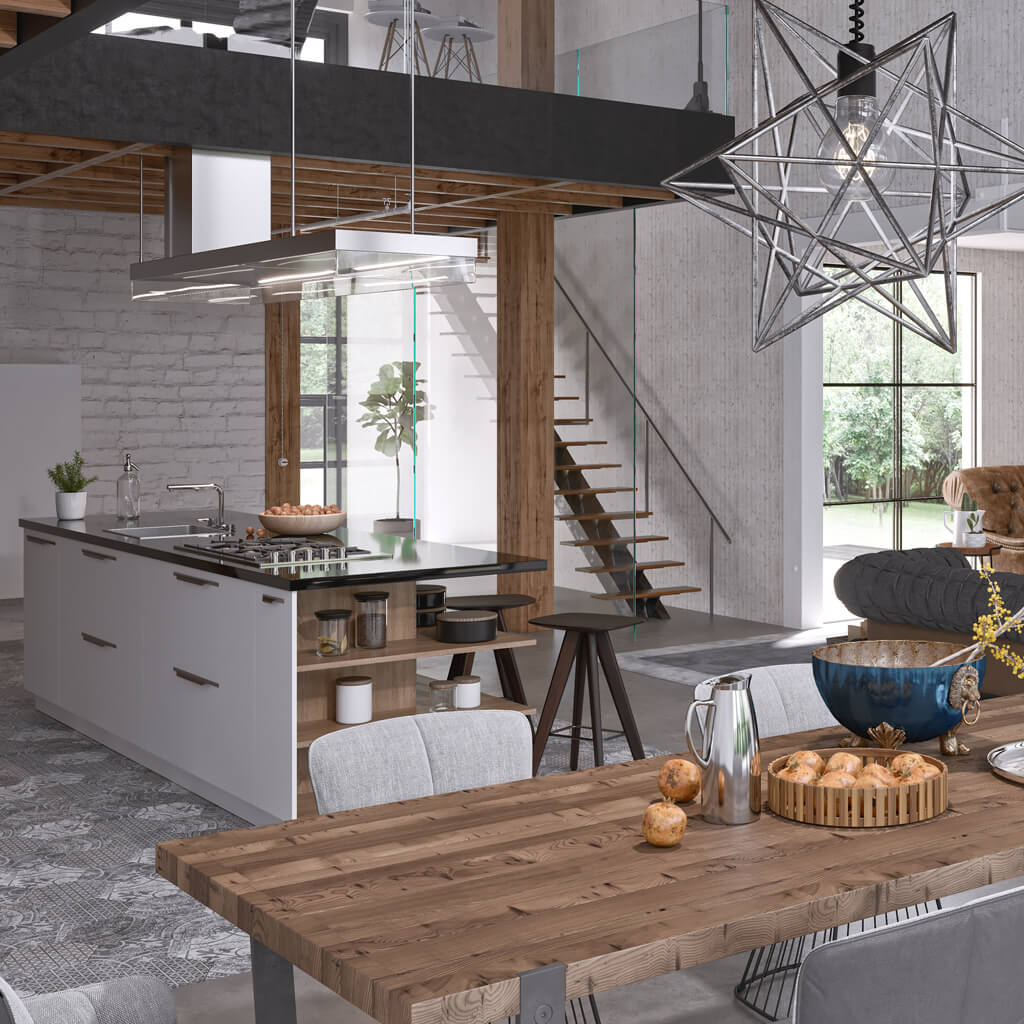
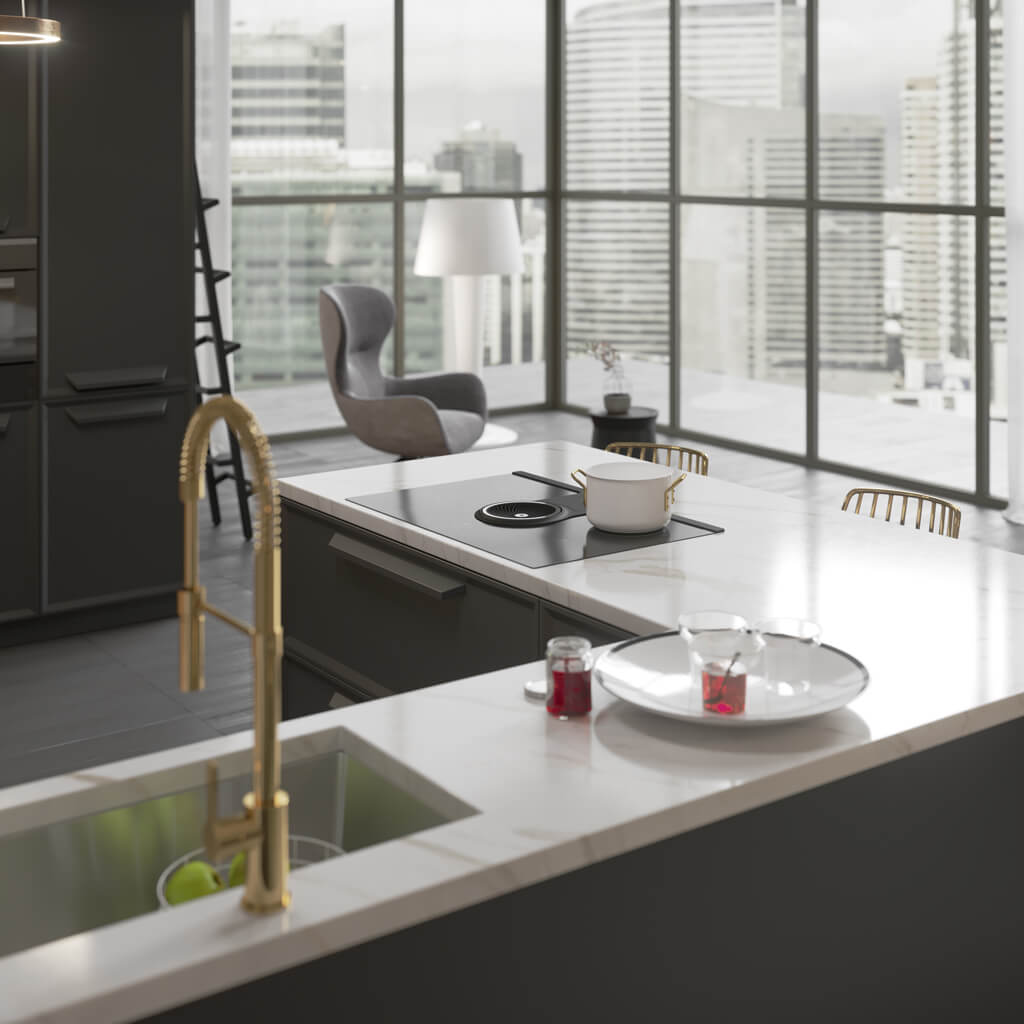
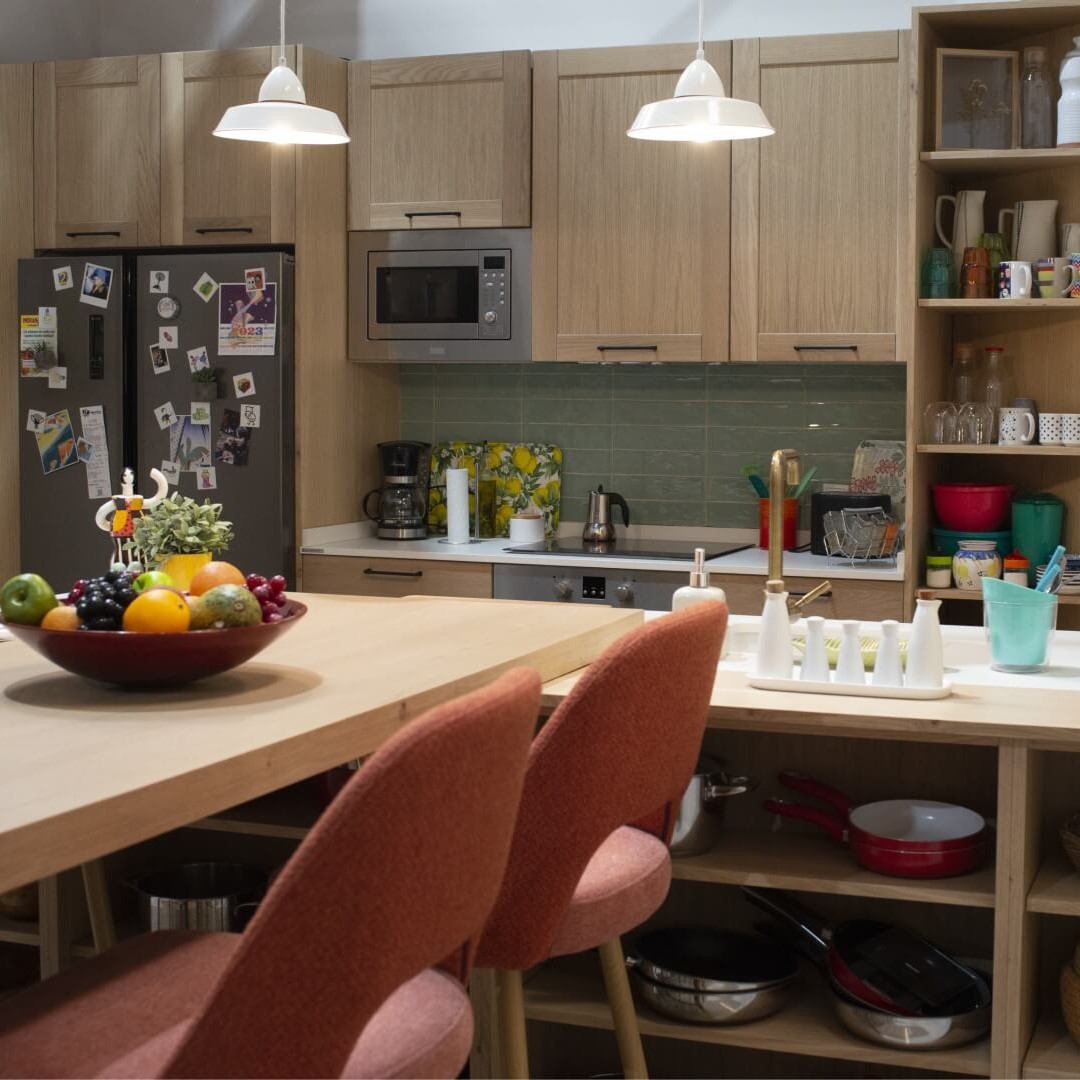
Kitchen islands are one of the most widely used solutions. They act as a transition element between the kitchen and living room, providing additional work surface and, in many cases, an informal area for eating or socialising. For this reason, open-plan kitchens with an island are among the most popular options today. Another common alternative is to use living room furniture itself, such as a sofa placed with its back to the kitchen, marking the beginning of each area without the need for walls.
Materials and flooring
Using different materials on the floor (for example, porcelain tiles in the kitchen and wood in the living room) allows visual differentiation of the areas while maintaining spatial continuity. This solution is particularly effective in projects involving small open-plan kitchens.
Strategic lighting
Lighting plays a key role in the layout of open-plan kitchens. Uniform general lighting combined with focused light points over the island or work areas helps define uses and create different atmospheres within the same space.
Layout and furniture
A proper open-plan kitchen layout should prioritise ergonomics, movement flow and storage capacity. Bespoke design allows each element to be adapted to the real dimensions and needs of the home, improving both functionality and overall aesthetics.
In this context, bespoke open-plan kitchens make it possible to tailor the design to the specific characteristics of each home and lifestyle. Custom manufacturing helps optimise the layout, properly integrate the kitchen with the living room and address key aspects such as storage, ergonomics and visual coherence between spaces. Solutions such as those developed by Kitchen Grup, based on made-to-measure furniture and high-quality materials, make it possible to create open-plan kitchens that stand out not only for their design but also for their functionality and durability, precisely adapting to the real needs of each household.
The open-plan kitchen as the heart of the modern home
Beyond an aesthetic trend, the open-plan kitchen represents a way of understanding today’s home. It is a space where not only food is prepared, but where people work, talk, do homework and spend time together as a family.
For this reason, its integration with the living room must be approached from a balance between functionality and design, taking into account technical aspects, habits of use and visual coherence. When these factors are combined effectively, the open-plan kitchen becomes the true centre of everyday life.